Collectibles · Product Design · 2026
VIIV.
Collectors don’t need another spreadsheet. They need a shelf that remembers.
A home for a 1:64 diecast collection — catalogue, card scan, orders, spend and habits — designed and built end to end in seven weeks.
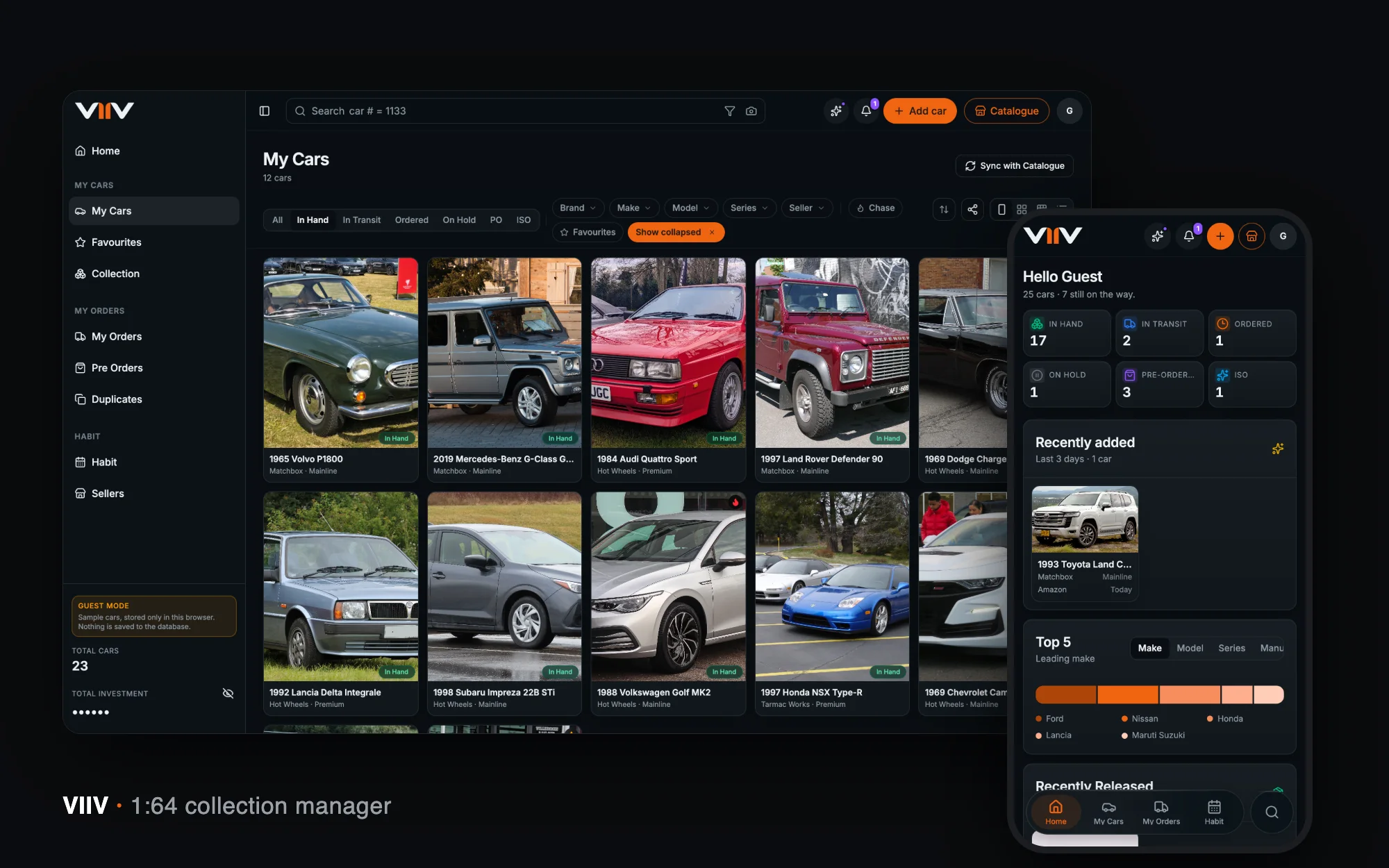
Real screens from the product’s demo mode (sample data).
- My role
- Product designer and owner — research, UX, UI, brand — with AI-assisted development (Claude Code)
- Duration
- 8 Sep – 27 Oct 2026 · 355 commits
- Industry
- Collectibles
- Platform
- Responsive web app, installable on a phone's home screen
- Tools
- Claude Code · TanStack Start · React · Tailwind CSS · Supabase · Vercel · Razorpay · Gemini (card scan)
Overview
The product, plainly
- What it is
- VIIV (viiv.si) is a collection manager for 1:64 diecast cars: a shared catalogue of castings, a private collection with status, price and copy details, orders and pre-orders, spend and buying-habit insight, and a scanner that adds a car from a photo of its card. The name reads VI.IV — the Roman numerals for 6 and 4, the scale.
- Why it exists
- It began as a dashboard for my own list of cars and grew into a product when the limits of the spreadsheet became the brief: nothing connects the car you want, the one in the post and the one on the shelf.
- Who it serves
- Collectors of 1:64 cars who buy online and pre-order releases — brands in the catalogue include Hot Wheels, Mini GT, Matchbox, Tarmac Works and Kaido House — and who want to know what they own, what is arriving and what they have spent.
- The problem
- Collections are managed in spreadsheets and disconnected tools. The same car appears under different spellings, orders live outside the list, and entering a car by hand is slow enough that the list goes stale.
- My contribution
- Product definition, information architecture, interaction and visual design, the brand (wordmark, app icon, ViiV Orange), and the direction of an AI-assisted build across 355 commits. I designed every screen shown here.
355
commits in seven weeks (8 Sep – 27 Oct 2026)
11 → 6
statuses, with “Late” derived
14
fields that fill from one catalogue pick
1,652
castings in the shared catalogue when captured
Stage 1 of 5 · Empathise
Know the collector
Research and discovery
VIIV started with one collector and one spreadsheet — mine. This stage is therefore honest about what exists: first-hand experience, the limits of the spreadsheet, and a clear list of what I still haven’t asked other collectors.
What kind of evidence is in this stage
- Research conducted
- Competitive observation
- Provisional persona
- Proposed validation — not yet run
Reading the product backwards. Looking at what the finished product asks a collector to record shows what a collection turned out to be made of:
- The car — make, model, series, colour, scale, brand, the box or blister it came in.
- The copy you own — what you paid, the retail price (MRP), condition, rarity, photographs of your own car.
- The order — seller, parcel, courier, tracking, the expected day.
- The want — a car you are still searching for.
- The habit — when and how much you buy.
The collecting loop
Conceptual diagram- Sees a new casting on a seller’s page
- Checks whether they already own it
- Places an order or a pre-order
- Notes seller, price and date
- Follows a parcel and a courier
- Loses track of what is arriving
- Reads the card
- Types the details in
- Browses the shelf
- Wonders what the year has cost
- “Do I already have this one?”
- “I’ll log it properly later.”
- “What is coming this week?”
- “Typing it all in is the chore.”
- “How much have I spent?”
- Look the casting up and see ownership before buying
- Record it as it is placed, with an expected date
- One shelf for what is on the way
- Photograph the card; let the catalogue fill the rest
- Spend, habits and a collection that looks like a collection
The release-day hunter
Buys online, pre-orders often
Follows releases closely and buys several cars a month from different sellers. Their collection is a stream of orders as much as a shelf.
Wants
- Know instantly if a casting is already owned
- See what is arriving and when
- Add a car without typing everything
Struggles with
- Orders scattered across messages and emails
- Buying a duplicate by accident
- Losing track of what has shipped
The shelf curator
Buys less, cares about the collection as a whole
Thinks in series, brands and sets. Wants the collection to be browsable, complete and presentable.
Wants
- See the collection by series, brand or set
- Spot what is missing
- Show the collection with photographs
Struggles with
- A flat list that cannot be grouped
- Inconsistent spellings of the same casting
- No photographs next to the data
Key insights
- 01A collection is three things at once: a catalogue of castings, the copies you actually own, and a pipeline of things on the way. (Retrospective — read back from how the product is structured.)
- 02A spreadsheet row can hold a car, but not the difference between a casting, the copy you bought and the parcel it is arriving in.
- 03Entry is the costly step. If adding a car is slow, a collection tool goes stale. (My working assumption; not yet tested with other collectors.)
Decisions made
- 01Treat the absence of research as a design constraint: make everything easy to correct (undo, edit anywhere) rather than assuming the first model is right.
- 02Use my own collection as the first real dataset, and be explicit that it is one perspective.
With a clear picture of what I knew, what I had assumed and what I hadn’t asked, the next question was which problem to solve first.
Next: DefineStage 2 of 5 · Define
Frame the problem
Problem framing and strategy
Three problems, in the order they hurt: getting a car in, knowing what you own, and knowing what is coming. The product principles below are the ones the commit history shows me actually committing to.
What kind of evidence is in this stage
- Retrospective analysis
- Proposed validation — not yet run
How might we…
- …let a collector add a car in seconds, without typing what the card already says?
- …decide, consistently, that two entries are the same casting?
- …show what is arriving, from whom, and how late it is?
- …let someone use the collection without ever exposing what they paid?
- 11 Sep
The phone is a first-class screen
Commit: “make the phone a first-class screen.” A bottom bar followed on 12 Sep.
- 12 Sep
Photograph the card instead of typing it
The scan flow starts here and is later renamed VIIV Scan (8 Oct).
- 18 Sep
One catalogue entry per car, one Car ID per car owned
The split between the shared casting and your own copy.
- 23 Sep
Eleven statuses become six
One shared status module instead of a dozen copies.
- 15 Oct
What you paid can stay out of sight
Privacy as a switch, not a setting buried in a menu.
Key insights
- 01Identity is the hard design problem. “What counts as the same car?” decides duplicates, ownership marks and what the catalogue can share.
- 02Money is personal. A collector may want the numbers, or may not want them on screen. (Observed: a hide-investment switch exists from the start.)
- 03Late is not a stage of a car’s life; it is a condition of an ordered car whose date has passed. The data model should say so.
Decisions made
- 01A casting belongs to everyone; a copy belongs to you.
- 02Photograph, don’t type — the camera is the primary way in.
- 03The phone is a first-class screen, not a shrunken desktop.
With the problem framed and the principles written down, the question became structure: what are the parts, and how do they connect?
Next: IdeateStage 3 of 5 · Ideate
Architect the collection
Exploration and solution architecture
The key move was separating what is shared from what is yours. Everything else — navigation, the add-a-car flow, the status model — follows from that split.
The domain model, as the commits record it. The shape changed more than once before it settled:
- 18 Sep — one catalogue entry per car, one Car ID per car owned.
- 18 Sep — a mix number is a case release, not a sub-series.
- 26 Sep — the number on the box decides what is one casting.
- 30 Sep — a casting comes in colours; a box is a name somebody keeps; the catalogue can be read as castings or as boxes.
The product ecosystem
Drawn from the shipped productShared catalogue
Everyone reads it; owners contribute
- Castings
- Boxes and assortments
- Brand marks
- Photographs
- Public casting pages
Your collection
Private
- Copies you own
- Six statuses
- Price paid and MRP
- Condition and rarity
- Favourites
- Wants (ISO)
The pipeline
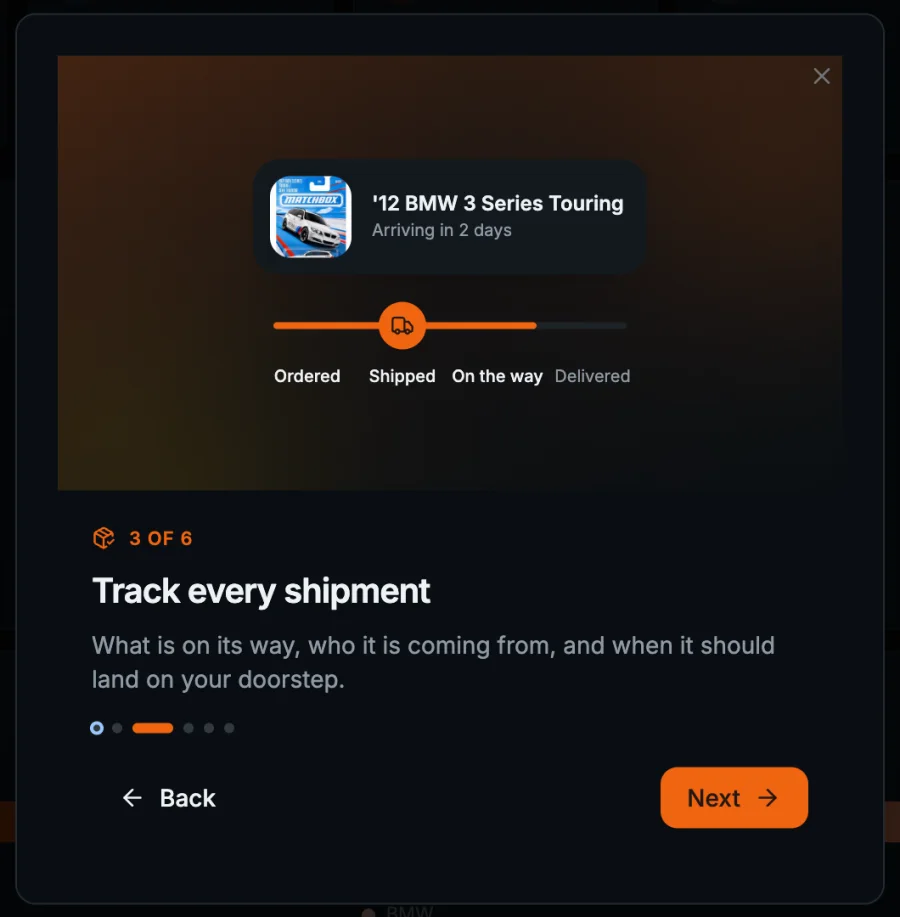
- Orders and parcels
- Courier and tracking
- Pre-orders
- Calendar of what is coming
- Sellers
Insight
- KPI tiles
- Top five by make, model, series
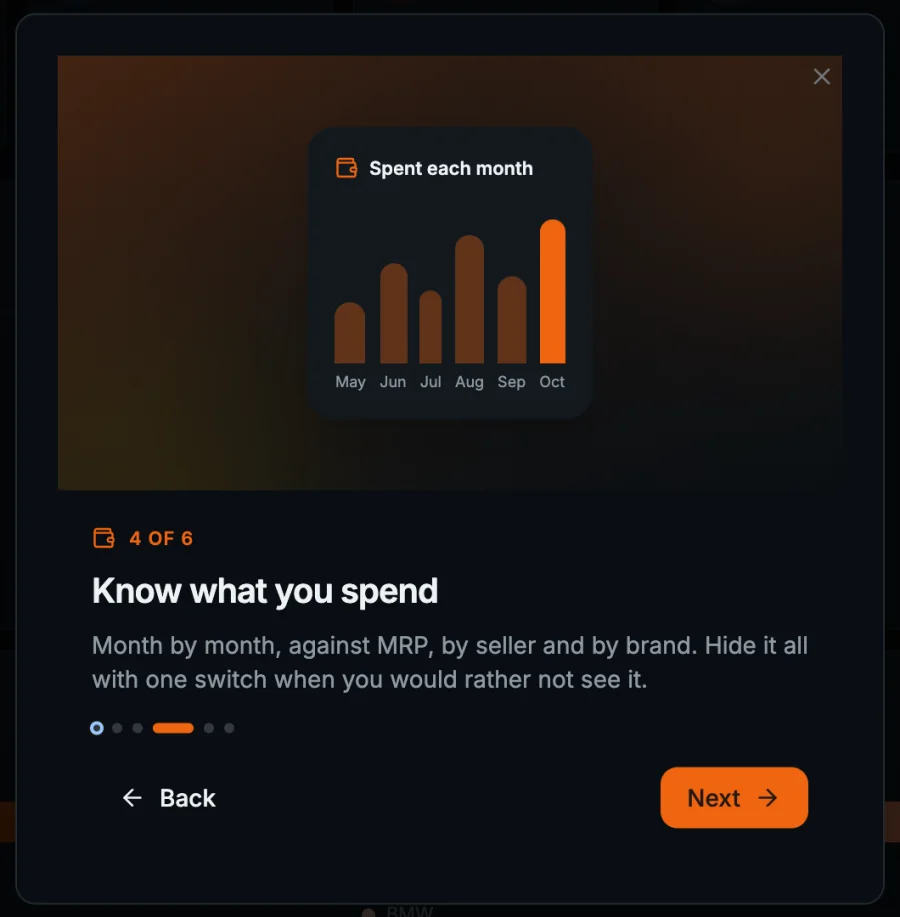
- Spend by month
- Buying-habit heat map
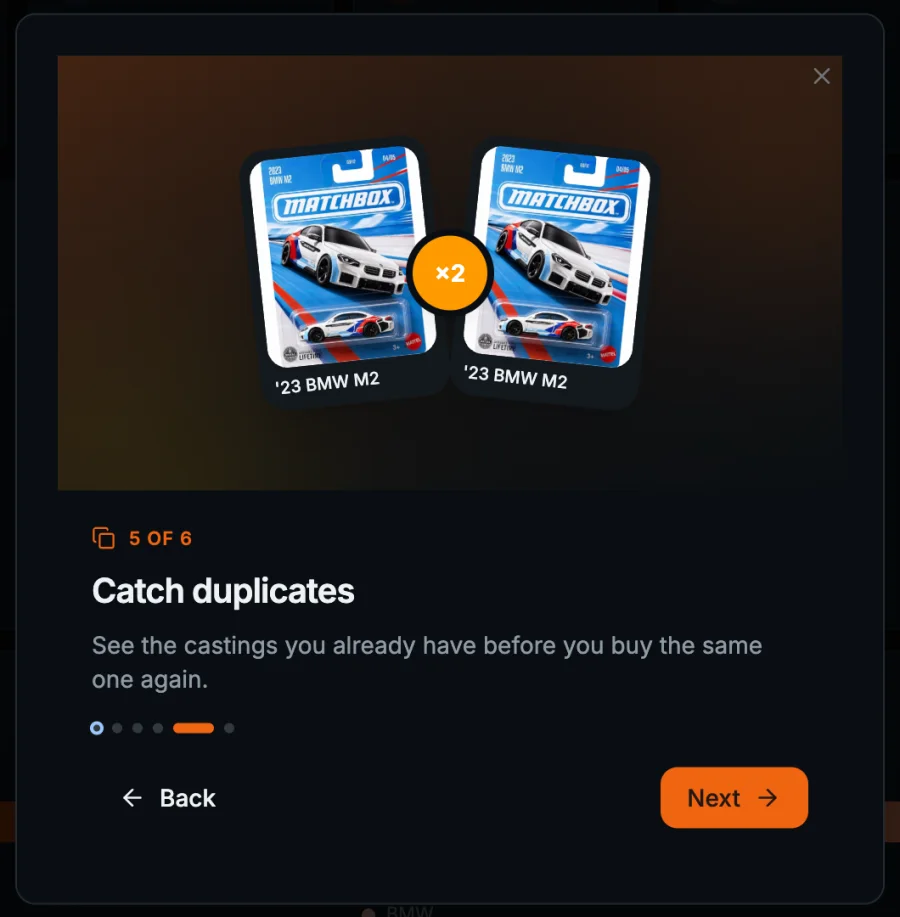
- Duplicates
Ways in
- Guest mode
- Scan a card
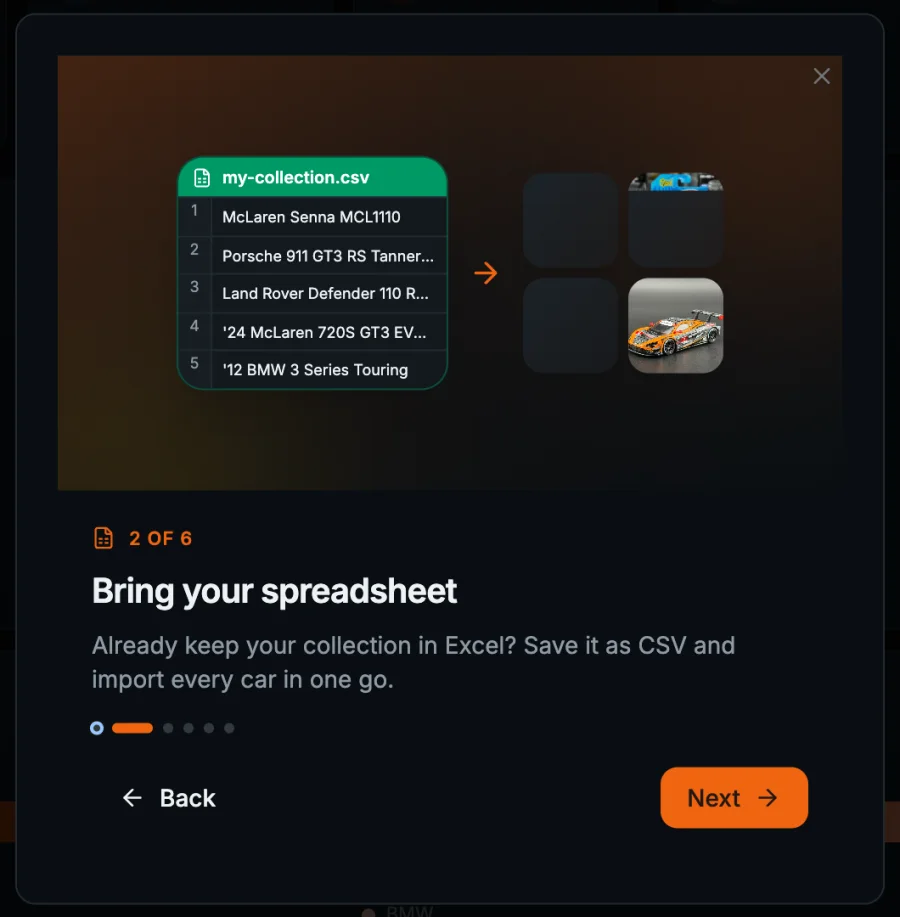
- Add in bulk (CSV)
- Welcome wizard
- Free, trial and paid plans
Information architecture
Drawn from the shipped productAdd a car
Drawn from the shipped productBefore 23 Sep — eleven spellings
- Available
- Available (In Hand)
- Transit
- Out for Delivery
- Waiting
- Delayed
- PO
- Pre Order
- Lost
- Wrong Item
- ISO
After — six statuses
- In Hand
- In Transit
- Ordered
- On Hold
- PO
- ISO
- “Late” is a badge worked out from the expected date, not a status
- 8 Sep
A dashboard for a spreadsheet
First commit, “My Diecast Dashboard”.
- 9–10 Sep
Accounts, per-user collections, guest mode, user-chosen handles
- 15–16 Sep
The catalogue — added, removed, then returned as a shared page
It was taken out of the navigation within a day, then came back as its own shared page once its job was clearer.
- 28 Sep
Every casting gets a public page; a calendar of what is coming
A stranger can read a casting without signing in; a collector can see their wants marked on a calendar.
- 7 Oct
Tesoro becomes VIIV
The working name was Tesoro; the product, wordmark and ViiV Orange arrive together.
- 13 Oct
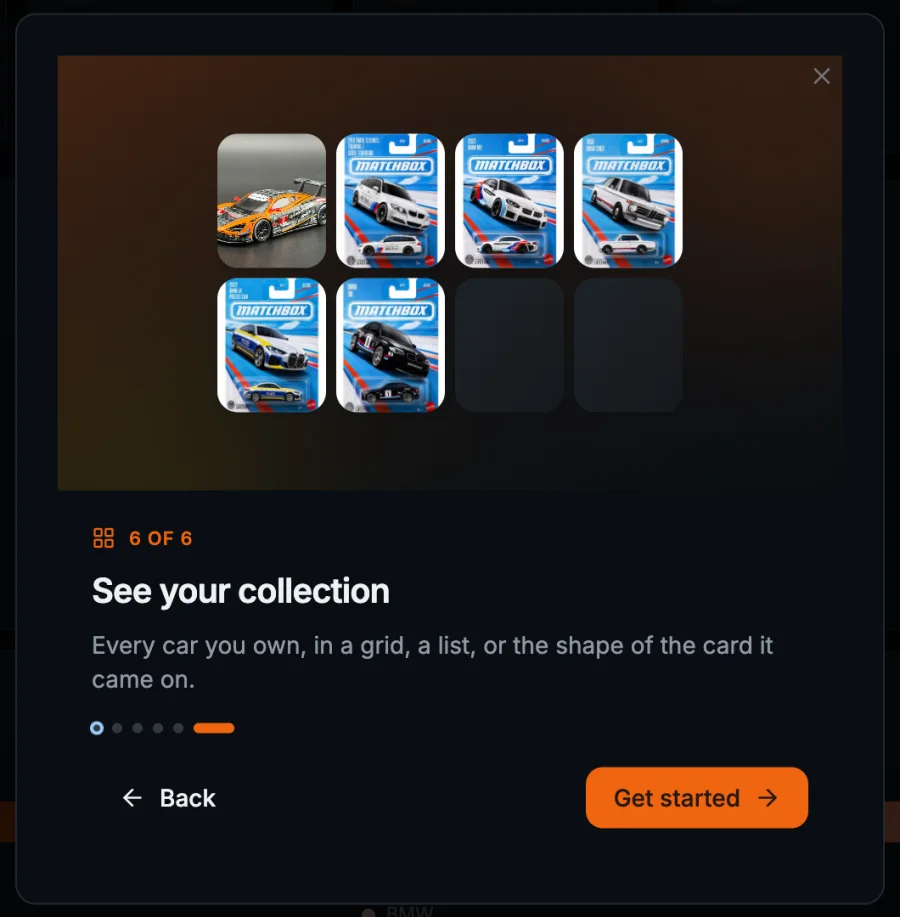
Blister view
“A view shaped like the packaging” — the fourth way to look at your cars.
Key insights
- 01A catalogue entry (the casting) and a car you own (the copy) are different things with different owners. Treating them as one row is what makes spreadsheets fall over.
- 02Navigation should follow the collector’s questions — What do I have? What is coming? What have I spent? — not the database’s tables.
- 03Status is a small, closed vocabulary. Six words cover the life of a car; lateness is derived, never stored.
Decisions made
- 01Shared catalogue + private collection, with a sync between them.
- 02Add a car in two steps: which car, then your copy.
- 03Six statuses in one module; “Late” becomes a badge calculated from the expected date.
The architecture was settled enough to draw. Time to design the screens a collector actually touches.
Next: DesignStage 4 of 5 · Design
Design the shelf
Wireframes, UI and prototyping
A dark, quiet interface where the cars are the colour and the orange is reserved for the next action. The same system runs from a wide desktop to a one-handed phone.
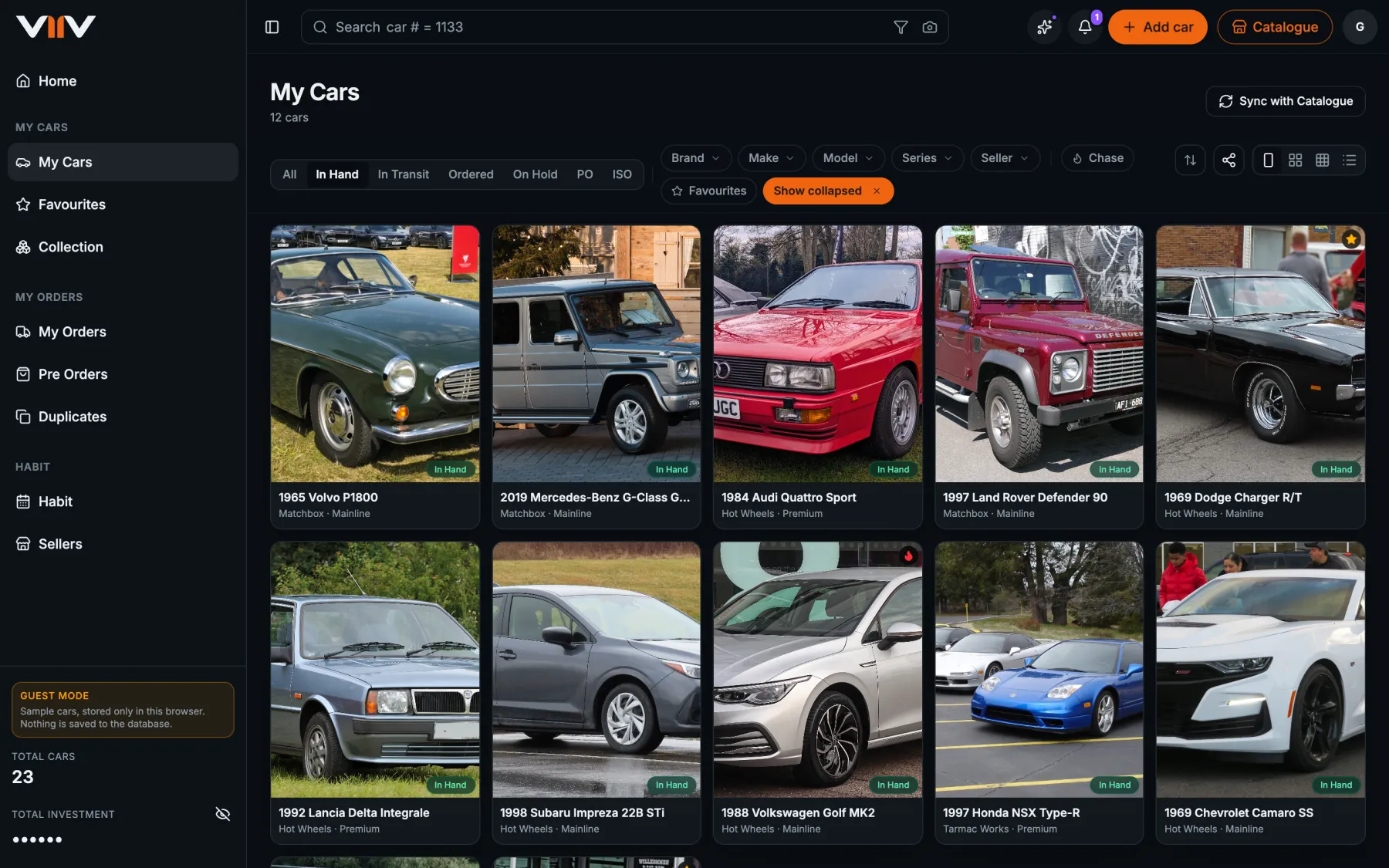
“I spent a LOT of time making sure it didn’t look like an AI-generated app. No random gradients. No generic dashboard.”
Design tokens
Drawn from the shipped productInter · UI and display
Know what you own.
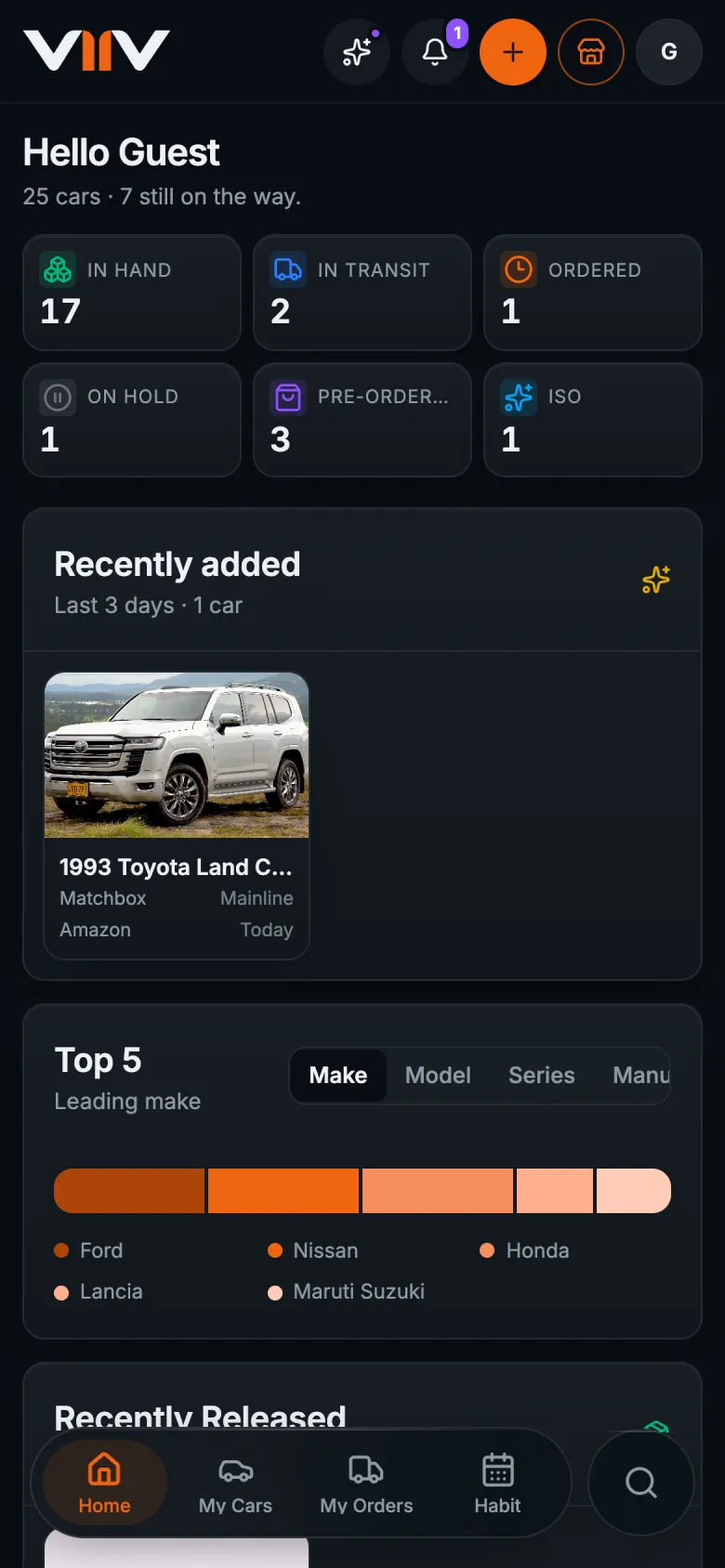
Home 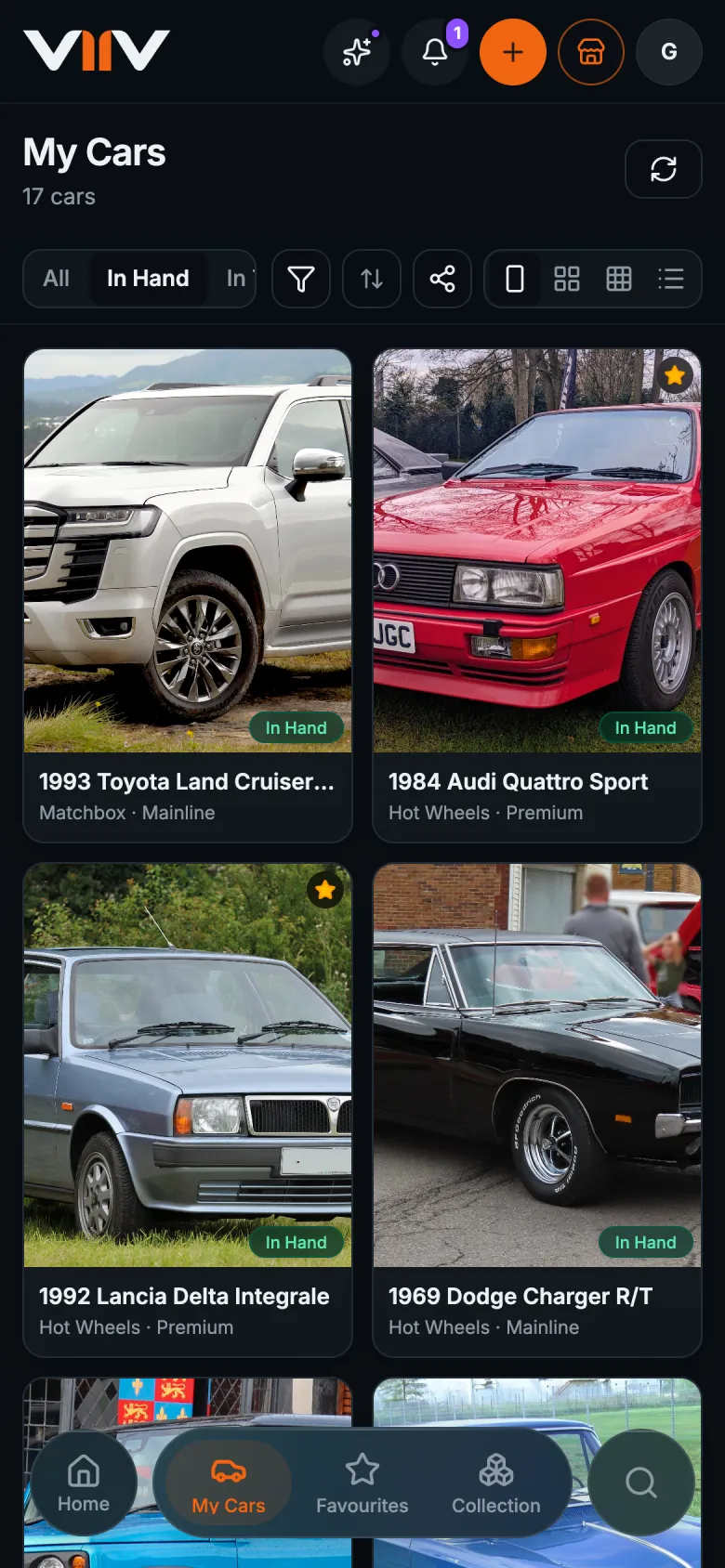
My Cars 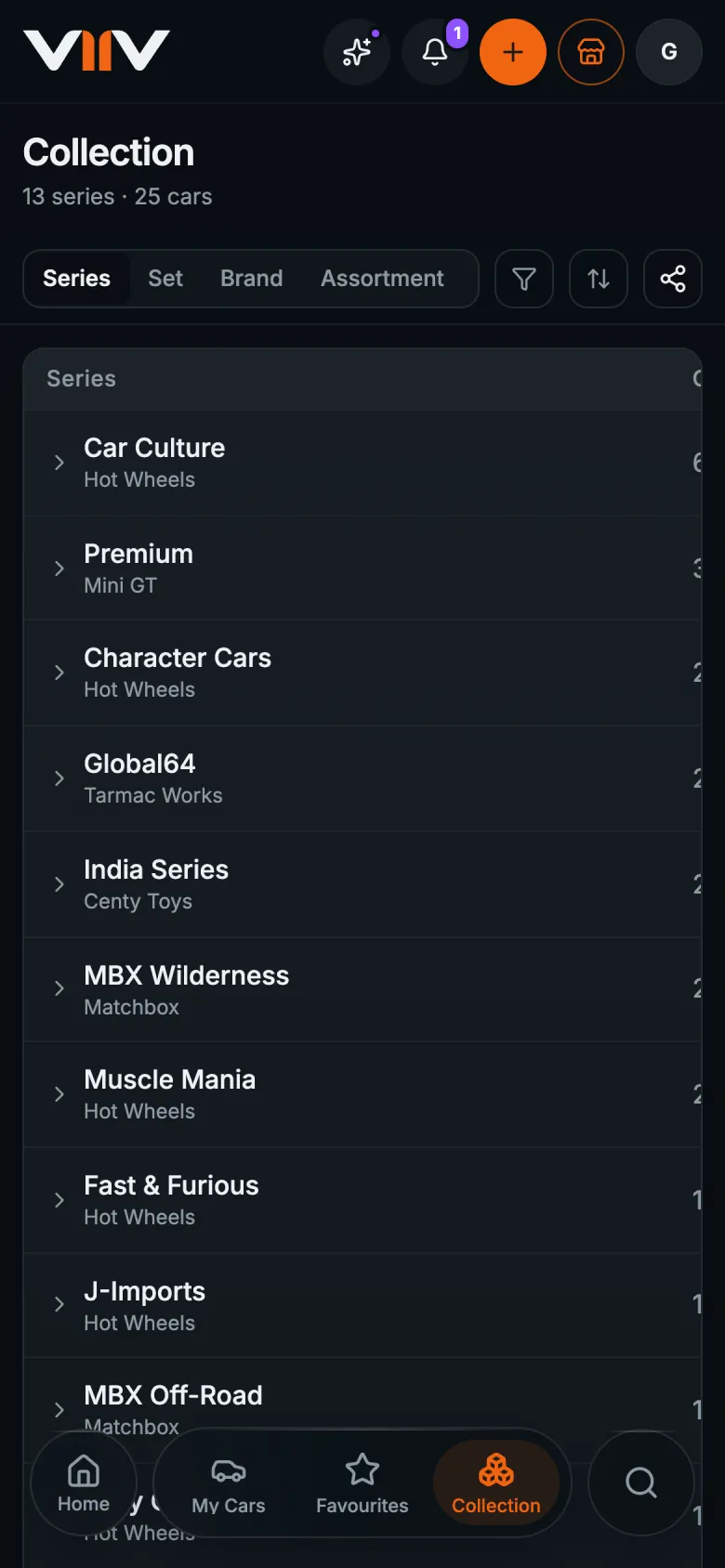
Collection
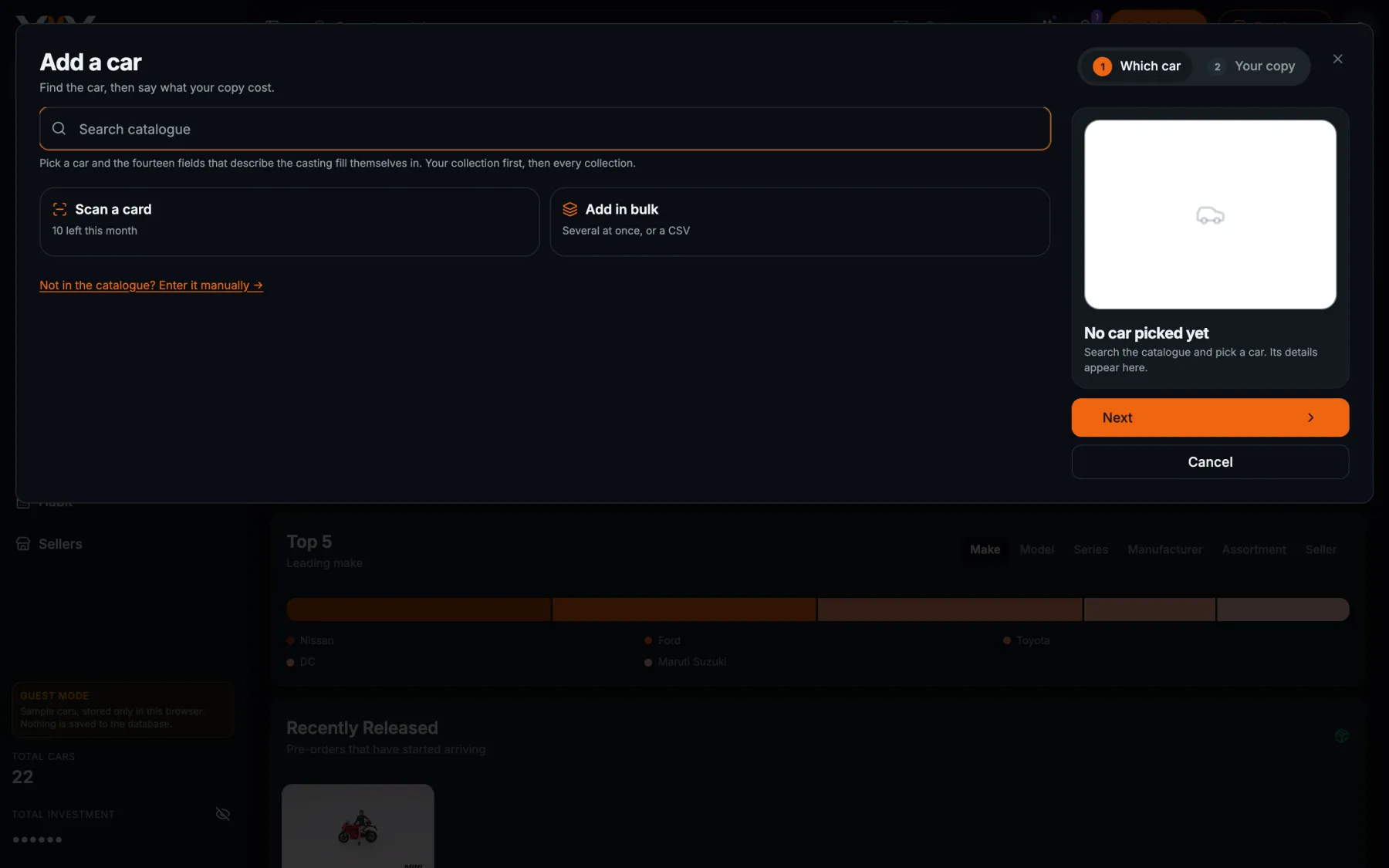
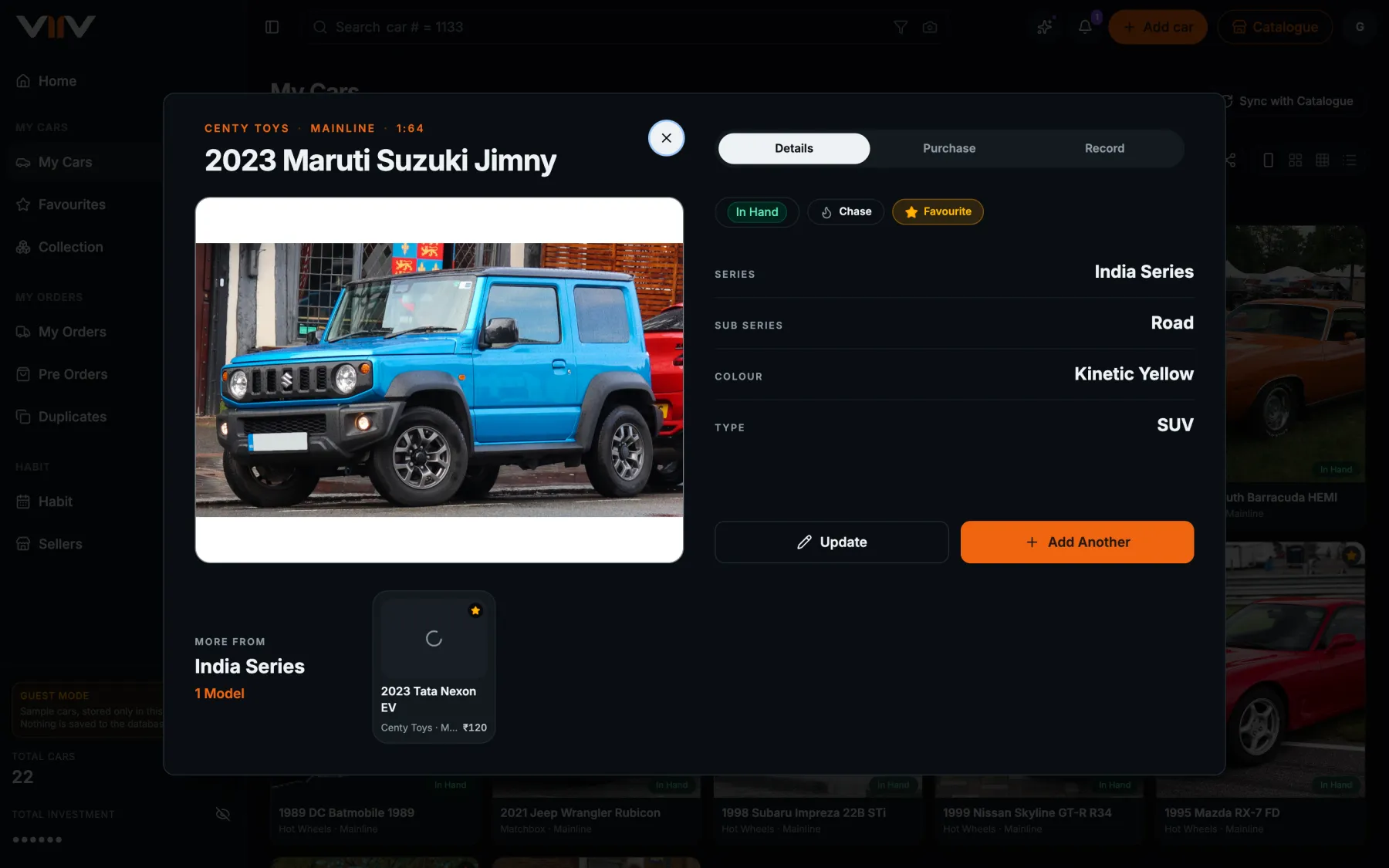
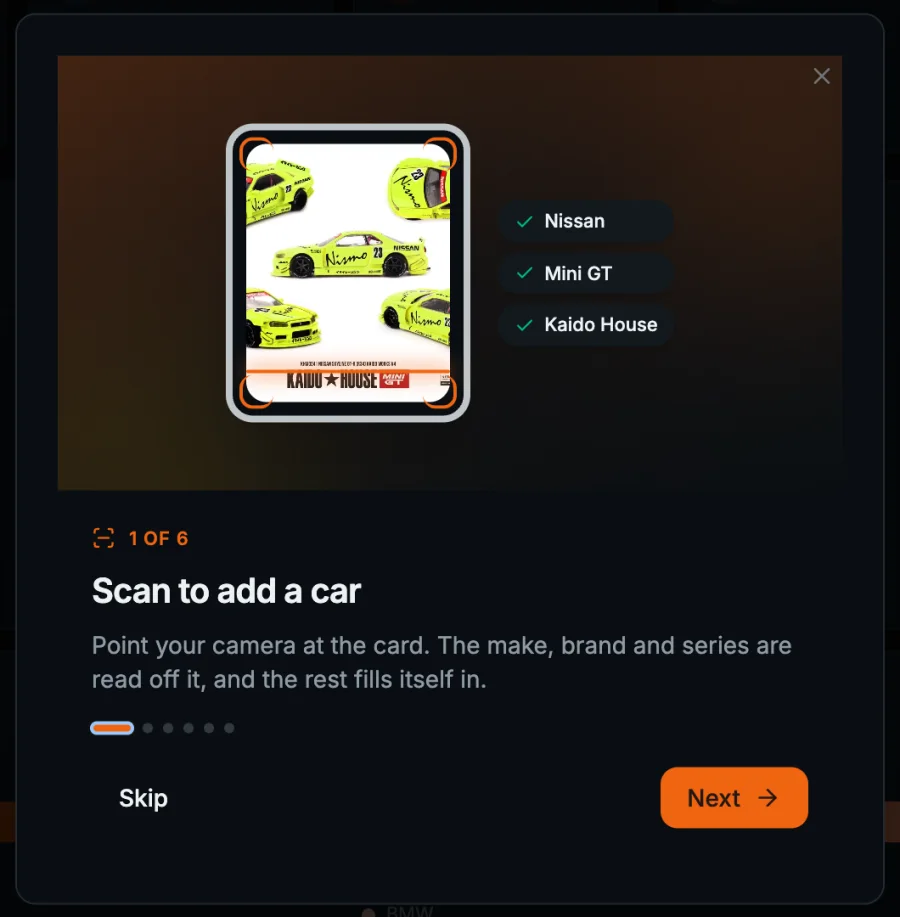
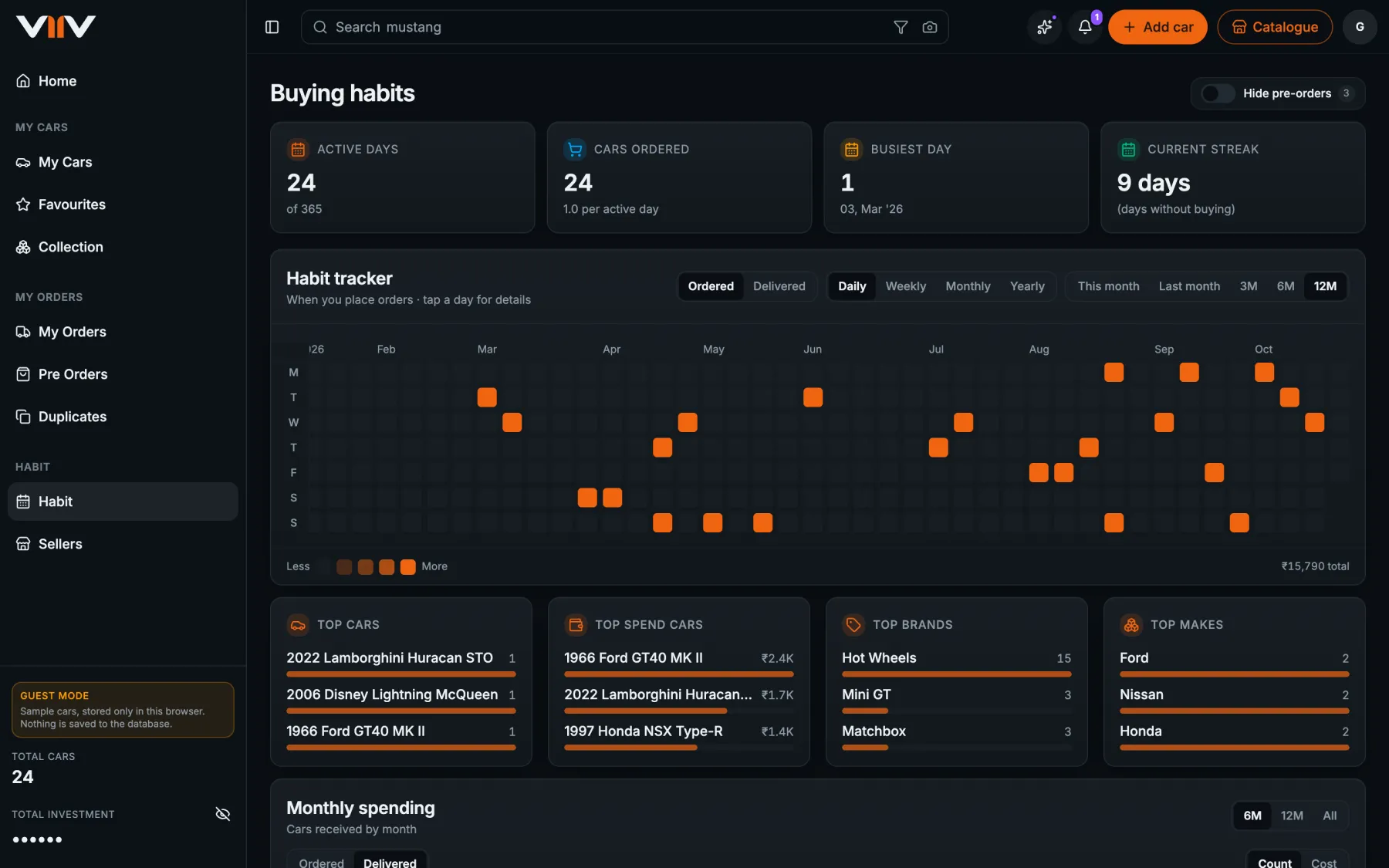
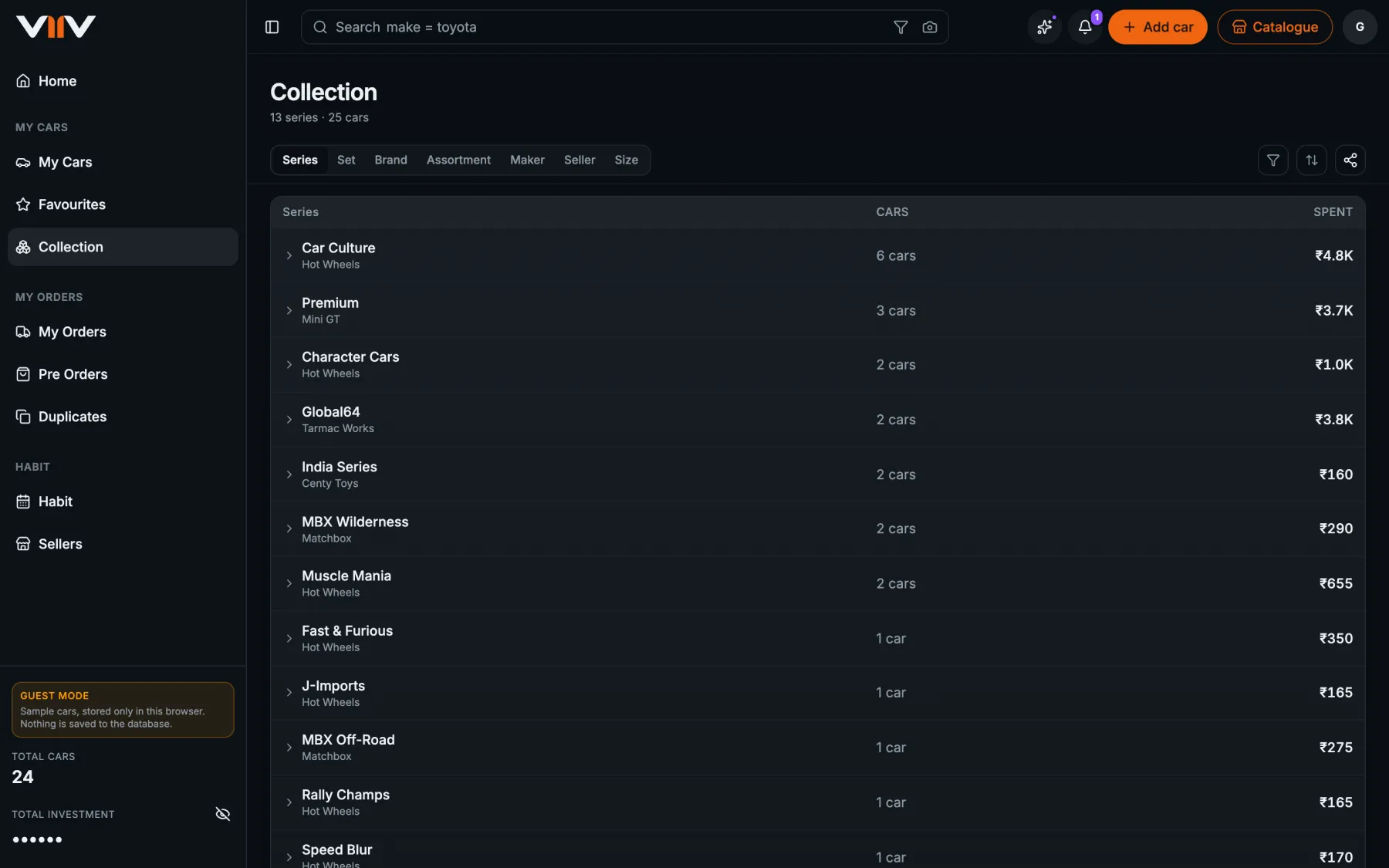
Try VIIV in Guest Mode
Open the live demoThis product blocks embedding for security, so the demo opens in its own tab.
Key insights
- 01Photographs carry the interface. With real car photos the grid needs almost no ornament.
- 02One page shape everywhere — heading, filters, content — means a collector learns the app once.
- 03Onboarding belongs inside the product: a six-step tour and a welcome wizard that only offers what the new collector picked.
Decisions made
- 01Dark by default, with light, OLED and auto appearances; orange only for action and identity.
- 02Four views of the same cars: blister, grid, compact grid, table.
- 03Car details in three tabs — Details, Purchase, Record — instead of one long page.
Designs this specific only mean something when someone tries them. What did testing look like — and what did it not?
Next: TestStage 5 of 5 · Test
Use it, break it, fix it
Validation, iteration and improvement
There has been no formal usability test of VIIV, and this stage says so. What there is: daily use on a real collection, a guest mode strangers can try, and a commit history that reads like a log of things used, broken and fixed.
What kind of evidence is in this stage
- Research conducted
- Retrospective analysis
- Proposed validation — not yet run
- 10 Sep
Keep a half-filled car through a phone going to standby
- 23 Sep
Stop the add-a-car form wiping itself every few seconds
- 24 Sep
Only a car in transit is asked for a courier
A form should only ask what the status makes relevant.
- 26 Sep
An import shows every field it will write, and can be taken back
- 29 Sep
A metadata editor, because a spelling was permanent
- 29 Sep
A duplicate has to be the same car — and says how close it is
- 13 Oct
Uploading a card left the camera on
- 27 Oct
A welcome wizard for accounts with no cars
Key insights
- 01Most of the fixes are about interruption: a phone going to standby mid-form, a form wiping itself, a camera left running. Real use finds the moments a happy-path design forgot.
- 02Correction is a feature. Undo, merge, a metadata editor and “take it back” on imports all arrived because a first version was wrong.
Decisions made
- 01Keep a half-filled car through a phone going to standby.
- 02Make imports reversible and show every field before it is written.
- 03Ship a guest mode so anyone can judge the product without signing up.
The work isn’t finished. Here is what I took from it.
What I learnedReflection
What I took from it
01
What I learned
Identity is the real design problem in a collection tool. Deciding what counts as “the same car” shaped the catalogue, the duplicate check, public casting pages and even navigation. I also learned how much a product improves when you stay inside it: most of the best decisions here came from using it, hitting a wall, and fixing the wall.
And I learned the limit of that: one collector’s instincts are a start, not a study.
02
Key design decisions
- A casting belongs to everyone; a copy belongs to you.
- Photograph, don’t type.
- Six statuses in one module; lateness derived, not stored.
- Add a car in two steps, with four ways in.
- Money can stay out of sight.
- The phone is a first-class screen.
03
Product impact
Not measured. The product is in beta (v0.9) and I am not publishing usage numbers, because I have no verified ones to show. What I can state: it was designed and built in seven weeks, it runs publicly at viiv.si, and anyone can try it in Guest Mode.
04
Opportunities for future development
- Interview and test with real collectors (plan under Test).
- A structured review of existing collection tools.
- Collector profiles that show a collection to others: handles and an account page exist; a public shelf does not yet.
- Community beyond the shared catalogue — following, trading, wishlists visible to friends.
- An accessibility audit of the dark theme and the scan flow.
“Good design isn’t just about creating interfaces. It’s about understanding people, connecting ideas and making complex experiences feel simple.”
Related projects
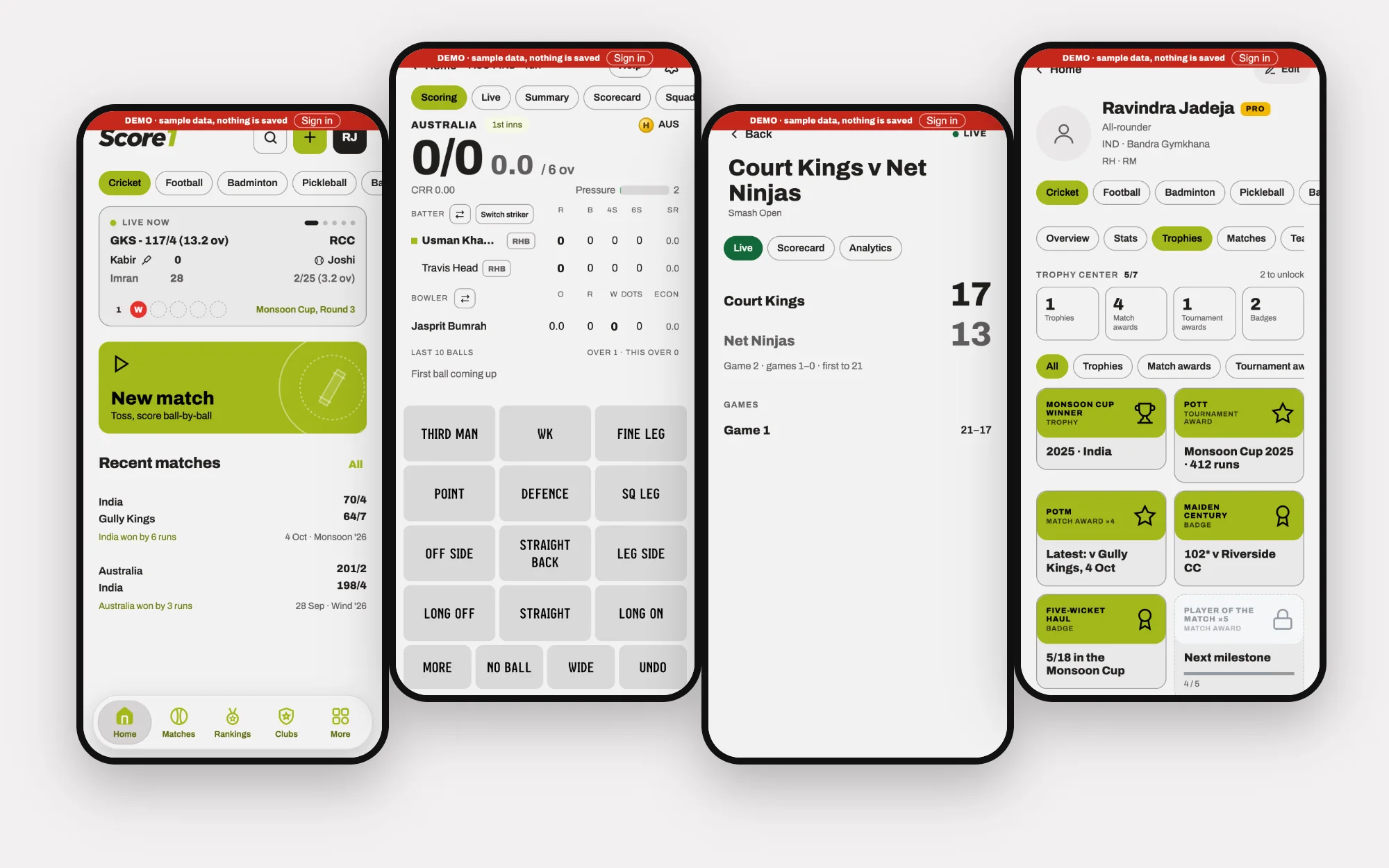
Amateur sport · Product Design · 2026
Score1
One app for scoring, tracking and connecting across nine sports — with the scoring depth cricket needs and the community tools clubs actually use.
View case studyProperty and rent · Product Design · 2026
RentPay
Rent management for small landlords and their tenants — one shared, trustworthy record of what is due, what was paid and what was said, in plain words.
View case studyLet’s talk
Have a challenge worth solving?
Whether you’re building a product, transforming an experience or looking for someone to help shape your design direction, let’s talk.